

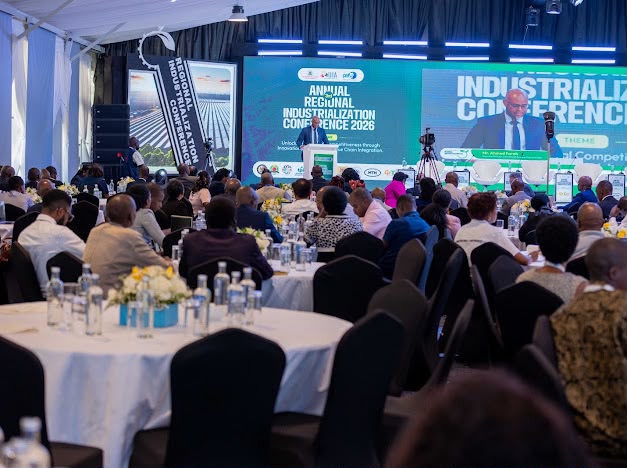
East Africa’s industrialisation agenda is increasingly moving from ambition to implementation. The just concluded 3rd Annual Regional Industrialisation Conference (RIC 2026), held on 18th–19th August 2026 at Kampala Serena Hotel under the theme “Unlocking Industrial Competitiveness through Innovation and Regional Value Chain Integration,” brought together public and private sector stakeholders to examine how innovation, investment, technology and regional value chains can drive industrial transformation. The conference was convened by the Private Sector Foundation Uganda (PSFU), the Alliance for a Green Revolution in Africa (AGRA), and the Ministry of Trade, Industry and Cooperatives (MTIC).
Represented by our CEO, Mr. Katende Jackson, CINAT Group’s participation in RIC 2026 provided an opportunity to engage with conversations shaping the region’s industrial future while exploring the practical role of technology, logistics, trade and strategic partnerships in connecting businesses to markets. The conference reinforced an important reality: industrialisation is no longer simply about producing more; it is about building the systems that enable businesses to produce competitively, move efficiently, access markets and scale across borders.
CINAT Group’s engagement at RIC 2026 reflects its growing interest in the intersection between strategy, technology, logistics and trade. The conference created a platform for the Group to interact with industry players, explore emerging opportunities and gain insights into the challenges businesses face as they seek to participate in regional value chains.
For CINAT, these conversations are directly relevant to its evolving business ecosystem. The Group’s interests across technology, logistics, trade and strategic communication position it to contribute to a more connected business environment — one where technology can help solve practical challenges and create pathways for businesses to access regional and international markets.
One of the strongest messages emerging from RIC 2026 was that industrial competitiveness depends on the strength of the entire value chain. A business may have the capacity to manufacture a competitive product, but without reliable logistics, financing, technology, distribution networks and access to markets, that product may struggle to reach customers beyond its immediate market.
This is where logistics becomes a critical component of industrialisation.
For SMEs in particular, the ability to move smaller consignments efficiently can determine whether they are able to participate in regional and international trade. Cargo consolidation, warehousing, distribution and digital logistics platforms can therefore play an important role in reducing some of the practical barriers businesses face when expanding into new markets.
CINAT’s logistics and technology interests also connect directly with this opportunity through BeezyLCL, a digital platform focused on Less-than-Container Load (LCL) cargo consolidation seeking to make cargo movement more accessible by enabling businesses that do not have sufficient goods to fill an entire container to consolidate compatible consignments. For smaller businesses, this creates an opportunity to move goods without waiting to accumulate a full container, while improving connections between businesses, cargo and logistics providers.
The relevance of solutions such as BeezyLCL extends beyond logistics, demonstrating how technology can address practical barriers to regional trade by improving connectivity, visibility and efficiency. For CINAT Group, RIC 2026 reinforced the importance of purpose-driven digital transformation — where technology goes beyond digitising existing processes to solving real business challenges, reducing barriers to market access and enabling businesses to connect with opportunities that may otherwise be difficult or costly to pursue.
East Africa’s industrialisation journey presents an opportunity to shift the conversation from simply producing locally to building products and businesses capable of competing regionally and across the continent. The RIC 2026 focus on regional value chain integration speaks directly to the need for stronger connections across sourcing, production, logistics, distribution, finance, technology and trade. The conference positioned industrialisation around stronger production ecosystems, technology transfer and the operationalisation of regional value chains that can position East Africa as a more competitive manufacturing and processing hub within the wider African market.
For CINAT Group, the conclusion of RIC 2026 should not mark the end of the conversation. It should be the beginning of deeper engagement with the opportunities identified during the two-day conference. The value of such platforms lies in what happens after the discussions — the partnerships formed, opportunities identified, innovations adopted and solutions taken to market. CINAT Group’s engagement therefore provides an opportunity to translate insights from the industrialisation agenda into practical business initiatives, strategic partnerships and technology-driven solutions.
East Africa’s industrial future will depend on how effectively businesses connect, innovate, integrate into regional value chains and access markets. For CINAT Group, engagement at RIC 2026 reinforces its opportunity to contribute through technology, logistics, trade and strategic partnerships. The key takeaway is clear: regional industrialisation must move beyond policy discussions and become a practical business strategy focused on connecting, moving, trading and scaling across borders.
RIC 2026 may have concluded, but the opportunity it highlighted is only beginning.