

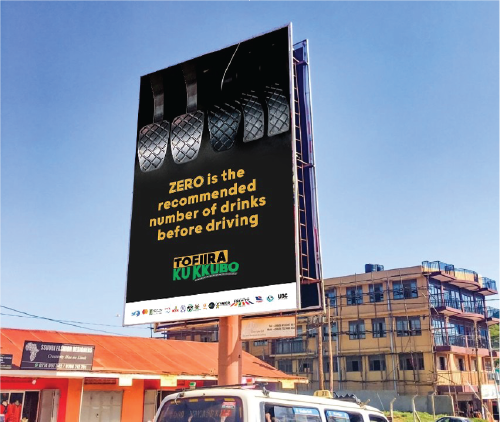
Uganda’s road safety crisis remains one of the country’s most urgent but often normalized public risks. According to the Uganda Police Force’s annual traffic report, over 5,000 lives are lost annually due to road crashes, translating to an average of 14–15 deaths every day. In 2022 alone, there were over 20,000 reported crashes, with a significant proportion involving pedestrians and young people. The World Health Organization’s Global Status Report on Road Safety ranks Uganda among the highest in Africa for traffic fatalities per capita. This is not only a transport issue, it is a social and economic catastrophe.
Globally, institutions such as the WHO emphasize that while awareness campaigns are important, they are rarely sufficient on their own. Sustainable impact requires a combination of behavioral change, stakeholder coordination, infrastructure investment, and consistent public engagement. Knowing this, the Tofiira Ku Kkubo Road Safety Fundraising Initiative was developed as a national effort to shift the conversation from awareness to action.
CINAT was entrusted with shaping how this initiative would be experienced, understood, and amplified. Our role extended beyond event execution. We led the strategic design of the campaign environment, covering branding, stage architecture, audience experience, and digital communication ensuring that the message carried both emotional weight and structural clarity.
The evening of launch of the initiative did not begin at the arrival of guests; it began days earlier, in the careful shaping of a visual identity designed to carry the full emotional weight of the cause. Every element of the branding was intentional, crafted to feel human, urgent, and quietly hopeful, a reminder that behind every contribution was not a number, but a life, a name, a story waiting to be protected.
By the time the lights dimmed and the dinner unfolded, the room was no longer just a venue. It had become a space charged with purpose, where even in silence, the weight of the mission could be felt, understood, and carried by everyone present.
As the programme unfolded, stakeholders from government agencies (including the Ministry of Works and Transport), the private sector (insurance companies, fleet operators), and civil society each bringing different expectations, priorities, and perspectives spoke candidly about the alarming state of road safety in Uganda. One police official noted that over 60% of fatal crashes involve speeding and reckless overtaking, while a representative from the Uganda National Road Authority (UNRA) highlighted the lack of pedestrian walkways in urban centers.
This diversity, while valuable, also introduced complexity. Aligning these voices, it became clear that road safety could no longer be addressed through awareness alone. It demanded a coordinated, well-funded national response. Within this context, the dinner evolved from a formal gathering into a platform where that collective movement could begin to take shape.
However, the campaign was not without its challenges.
One of the primary constraints was public desensitization. Road accidents have become so frequent that statistics alone no longer create urgency. When people hear “15 deaths per day,” the number blurs into background noise. Communicating impact required moving beyond numbers to human stories real lives, real loss, and real consequences. CINAT addressed these challenges through a layered approach: designing a human-centered visual identity, integrating digital storytelling across phases, and structuring the experience to encourage active participation.
Inside the room, the evening was shaped by responsibility and shared commitment. Guests listened intently to insights from road safety experts, including a trauma surgeon who described the nightly toll on emergency rooms, and lived experiences from communities most exposed to risk such as boda boda riders and market vendors who cross highways daily. As the dialogue deepened, appeals were made, pledges were offered, and the fundraising momentum steadily grew with each passing moment.
By the end of the night, the atmosphere had shifted. What began as attendance had transformed into ownership. Those who arrived as observers left with a sense of responsibility, while stakeholders who came in curiosity departed fully committed to the cause.
For CINAT, this was more than event execution. It was a contribution to a national movement, one that speaks to every family, every community, and every young person with a future still ahead of them. Our role was to build the bridge between intention and impact, ensuring the conversation had the structure, visibility, and emotional depth required to move people toward action.
Ultimately, this was not just about organizing a programme. It was about enabling influence. Because when awareness is designed with precision and purpose, it does more than inform, it compels response.
We are proud to have been part of a night that extended far beyond the programme itself, one that reminded the country that youth road safety is not a statistic to be read, but a responsibility to be owned. It was a night that transformed concern into commitment, and in doing so, laid the foundation for a stronger, more unified national effort to save lives on the road.